This past Saturday I finally climbed a route I have had my eye on and attempted several times over the last 5 years. The route was a growing process for me and my ice/mixed climbing.
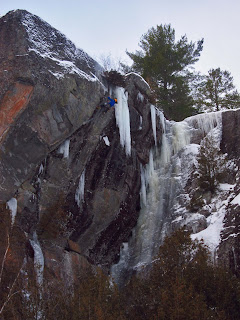
The 35m route at Diamond Lake climbs up the overhanging wall left of the iced up corner. It starts on thin ice smears and some drytooling before accessing the right leaning crack and finishes on the large dagger at the top.
This line had been looked at for years and even saw a few attempts before I first saw it in the winter of 2007-2008. It was thin and I was still very green when it came to sketchy mixed climbing. The first time I saw it I didn't have the rock gear along to even think about trying it. Later on that winter I returned with rock gear, stubby screws and a few bolts. Looking at it I could see that it was in no condition to even try to attempt. The thin ice was even thinner and water was running behind it. I knew I could bolt it into submission and climb it, but such a line deserved better that that. It would have to wait for another year.
At the start of the 08-09 season I did as many hard ice and traditionally protected mixed routes as I could find to prepare myself for the project. Upon returning to Diamond Lake I was hugely disappointed to see that someone had come along after I had been there the year before and started bolting their way up the wall. Because they had bolted it so late in the season most of the bolts were buried under several inches of ice. I decided at that point all their bolts were completely unnecessary and would not use them, if for no other reason just to prove a point. I climbed the lower ice section of the route to the base of the headwall on removable rock gear and ice screws and replaced an old piton anchor with a modern bolt anchor at the end of the ice and called the lower ice route done so no more bolts would be placed.

The winter of 09-10 I was hopeful that I would climb the project. Upon returning that year the ice down low was much, much thinner than the year before and rather than risk climbing the thin hard to protect ice or clipping the bolts I climbed a crack system that diagonals up and right and joins the line at the huge flake system just to the left of where I'm at in the above photo. From there I could continue upward. Climbing past the high point from the year before I finally reached the headwall where the angle of the rock kicks back into your face.
 |
| Climbing past the midpoint anchor on an early attempt. Photo by Colin Matthews |
Climbing into the headwall I got a few pieces of gear into the crack and climbed to the headwall dagger. After drapping a sling over a hollow flake I reached up for the skinny dagger and swung. It broke right off leaving me without much to work with. reaching far up over my head I managed to drive an ice screw straight up into what remained of the dagger. After contemplating how tired I was, how far below the last good piece of gear was and how far up the ice filled crack the next opportunity for gear might be I drilled a bolt and lowered off. I came back a few more times that year, but the ice quickly deteriorates from week to week and the bottom became harder and harder to climb. I was never able to push the high point any further without hanging all over the rope so I would just lower off.
2010-11 had a very dry fall and the ground water needed to form the route was not there. After one trip out that year I decided I might as well come climb it in summer if I wanted to rock climb and went elsewhere to find ice or drytool.
Last fall the 2011-2012 season seemed to be quickly approaching and while the project was on the back of my mind I was wondering if I would ever actually be able to climb it. Every year I plan to start training early, but rock climbing seems to always take priority right up until its ice season and I'm left scrambling to get back into good form for ice climbing.
With some pushing from Rebecca I finally decided to apply to climb in the Ouray Ice Fest Comp. At the very least it was a great way to finally take training somewhat seriously and get into wicked good shape for ice season and hopefully the project.
After returning from Ouray the project was next on my agenda. I saw some photos of the lower ice which looked encouraging, but still looked really thin. The weather was miserably cold but I reasoned that we had been out there trying to climb it in simlar conditions before so we made the long drive up. On Saturday I didn't even get on the route. We both had such a hard time keeping warm on the warm-up we would have likely froze to death if I tried the project. On Sunday we got a late start but I managed to climb the thin ice of the lower section. By the time I got to the midpoint anchor I was pretty exhausted and the daylight was fading quickly. I lowered off and made plans to be back the next weekend if the weather looked better.
A late start and some slippery roads were not a great way to start the day. We quickly did a couple of easy warm-ups and then headed over to see what had happened to the thin ice smear on the project.
The thinnest parts were already showing signs of evaporating away but it still looked okay. After some possible groundfall potential down low, the upper smear was still really good and took 13cm screws like a champ. The drytool section was a little sketchy since a large part of the face was covered in verglass and a light dusting of snow obscuring some of the holds.
After reaching the anchor at the top of the ice I was still surprisingly full of energy. It could have been in part because Martin Suchma was busy clicking away with his camera in hopes that I would put on a good show.
Launching into the headwall the ice covering some of the holds was crappy, dried out and crumbling. Fortunately there are good rock holds underneath to allow passage. Upon reaching the center headwall dagger I was pleased to find clear and solid ice, but not so happy to have the obstacle to climb around. Hoping it would make for good footholds once higher I elected not to knock it off. I clipped the bolt marking the highpoint and had a sigh of relief to know that even if I ripped all my gear or didn't get anything into the ice filled crack and I ended up taking a 70'+ fall from near the top, at least I wouldn't be hitting the ground.
 |
| Photo by Adrienne Tam |
|
Getting around the dagger was one of the more difficult sections. I had to carefully tap at the ice to make small divots to hook into. With my arm locked off and reaching as high as I could I twisted my body around the dagger like serpent. Above the dagger was the thin, ice choked crack.
As I climbed the ice inside the crack the bolt got further and further away. After 15 feet or so there was a pod inside the crack that took a marginal cam. A few feet above the cam was a fixed piton left by someone from a long ago aid climbing adventure. The bomber looking fixed pin I had spied from below turned out to be an under driven rusted out piece of crap. I was a little surprised when I clipped the rope in and it didn't break. But any port in the storm is a welcome one.
I slowly worked my way up the steep headwall. The crap gear getting further and further below me and the bolt seeming miles away. Finally nearing the top I found another pod that would take a cam, but the two pieces of the size I needed were far below as I tried to work in the next size up. It finally slipped in just far enough to grab and I continued upward. What seemed like spitting distance from the reaching the top of the cliff the ice inside the crack ran out and was replaced by a thick coating of moss.
 |
| Photo by Adrienne Tam |
Try as I may the moss just scraped off and wouldn't hold my tool and the crack was too flared to torque my picks into. After hanging out and assessing what to do I decide my best bet was to lunge up to the small ledge way over my head and hope it wasn't sloping and would hold my pick. I tossed up for the ledge and my pick stuck into the thin layer of soft ice. Looking over the ledge I was happy to find a couple more fixed pins that looked like they might actually hold a fall. I happily clipped both.
 |
| Photo by Adrienne Tam | |
By this point I was pretty gassed. 10 feet from the top and only a few feet from solid ice I carefully worked my way upward. Swinging into the dagger at the top felt good, but it still wasn't quite over since I was carrying a ferocious pump and could barely swing my tools. A few more tenuous moves and I was finally at the top!
It took me about two hours to to climb the route with the only no-hands coming at the top of the huge flake in the lower ice section just before the first/lower drytool crux.


